


Corporate Due Diligence & Choosing the Right Grease Management Equipment
Date Published
After a recent change to the operational management team at one of our corporate customers, they asked during an early meeting whether they had chosen the right grease management equipment. It’s an excellent question, and an even better one to answer.
There are several grease management solutions, each with a wide range of products. Choosing between them can feel like a minefield, with every provider claiming its product is the only one that can meet all your fats, oils and grease management needs. That can’t be true, of course.
Manufacturers are unlikely to tell you when their product isn’t the right fit for you. They’ll quite happily force a round peg into a square hole. This leaves commercial kitchens at risk of buying the wrong product and, more worryingly, one that doesn’t work, adding FOG to their drains and the public sewer network and wasting hard-earned cash.
Our Due Diligence Process
To reassure the new management team, we walked them through the thorough due diligence we had completed before recommending that specific product.
Deciding what needs protecting and whether to choose grease recovery units or passive separators should always be the start of the journey. The equipment must suit the kitchen’s wastewater, but it also needs to work with the people and routines responsible for looking after it.
Identifying the Risk Areas
First, identify risk areas: not all grease traps, whether passive or mechanical, are suited to every kitchen setup. For instance, some grease recovery units aren’t designed to work with high-temperature dishwasher discharges, a limitation their marketing materials may not make clear.
Before recommending equipment, it is important to establish what will discharge into it and whether the selected model can handle the temperature and flow rate. A product that works well on one kitchen connection may not be suitable for another.
Staff and Operational Realities
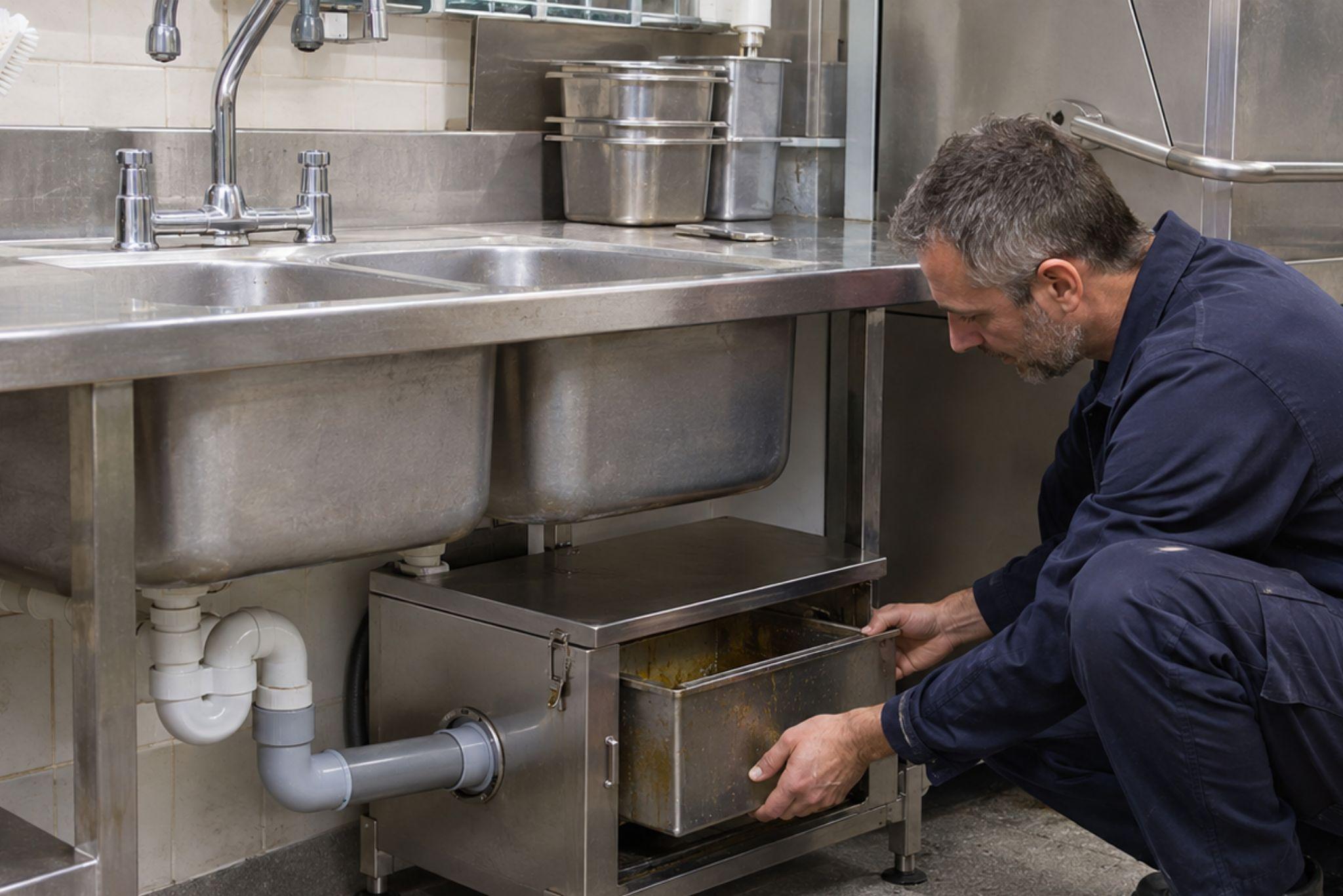
Secondly, staff and operational realities: passive grease separators require substantial daily attention from kitchen staff. In businesses with high staff turnover, this maintenance is often overlooked. Before long, the unit can begin to smell, and FOG can escape into the drain.
In this instance, our customer chose grease recovery units specified for the relevant pot-wash, food-preparation sink, coffee machine, oven and dishwasher connections. Staff turnover and the risk of foul odours from missed maintenance ruled out passive separators for this business.
Automatic equipment still needs regular cleaning and servicing. However, the daily maintenance requirements were a better fit for the customer’s operational needs.
Why the Menu Matters
Beyond the risk areas, you must also consider the menu. This customer cooks large volumes of dairy products and animal fats, so the chosen system needed to manage both emulsified FOG, dispersed through the wastewater, and free FOG, separated from the water.
As with the dishwasher challenge, many manufacturers do not clearly state whether their products can handle only one or both of these states. The customer needed a reliable range with flexible flow-rate capacity, a sensible price and the ability to handle both forms of FOG. For this business, the GreaseShield range was the perfect fit.
Giving the Management Team Confidence
After outlining this process, the new operations team fully understood the decision, approved the strategy and moved forward with full confidence.
A key benefit of choosing an independent specialist like Grease Guru is that we’re not tied to a single manufacturer. We won’t try to fit a round peg into a square hole. You can be confident that our recommendations are based entirely on your operational needs, rather than a manufacturer’s sales targets.
Kelvin Charles
Jul 14, 2026
Alex and the team at Grease Guru have been brilliant in assisting in diagnosing and resolving ongoing drainage and grease trap issues for us. It seems that with their advice we now have a workable solution in place that has improved things all round, and all done flexibly and quickly working around our schedule.
Laurence Barwick-Smith
Jan 16, 2025
Very knowledgeable team, always responding quickly to enquiries to keep projects moving. Fast, professional service, we will certainly work with them again in the future.
Emma Sykes
Dec 22, 2022
I contacted Grease Guru looking for advice, they promptly offered a free no commitment site survey to determine our requirements. The surveyor was very helpful and explained all our options. We were then given a detailed proposal which we confirmed was acceptable with the water authority before continuing. The traps were installed soon after and have been running great since.
How Grease Guru Can Help Your Commercial Kitchen
At Grease Guru, we help commercial kitchens establish whether their grease management equipment is right for the job. Whether you are reviewing an existing installation, changing your kitchen equipment or planning a new site, we can assess the requirements and recommend a suitable solution.
Our services cover grease trap and grease recovery unit installation, servicing, maintenance and repairs. We consider the connected appliances, wastewater flow, grease output and daily maintenance requirements, helping you choose equipment your kitchen team can manage effectively.
Is your kitchen’s grease management system up to the task? Speak to a member of the Grease Guru team to discuss your current setup, arrange an assessment or find out how we can support your business.
Frequently Asked Questions
How do I choose the right grease trap for my commercial kitchen?
Start by identifying which sinks and appliances need protecting, their wastewater flow rates and discharge temperatures, and the fats, oils and grease your kitchen produces. The daily maintenance requirements also need to suit your staff and working routines. Grease Guru assesses these factors before recommending equipment.
Can a grease recovery unit handle dishwasher wastewater?
Some grease recovery units are suitable for dishwasher connections, but this should never be assumed. The selected model must be specified for the dishwasher’s discharge temperature and flow rate, with the installation arranged according to the manufacturer’s requirements.
What is the difference between emulsified grease and free grease?
Free grease separates from wastewater, while emulsified grease is dispersed through it as small droplets. Not every grease management product is designed to deal with both, so the type of FOG produced by the kitchen needs to be considered when choosing equipment.
Is a passive grease separator suitable for a kitchen with high staff turnover?
It can be, provided there is a reliable daily maintenance routine, suitable training and clear responsibility for the work. Where staff turnover makes that difficult, a mechanical grease recovery unit may be a better operational fit, although it will still require cleaning and servicing.
Can Grease Guru assess an existing grease management system?
Yes. Grease Guru can review your current setup and assess whether the equipment is suited to the kitchen’s appliances, wastewater and operational needs. This can help establish whether the existing system remains appropriate or whether changes are needed.
Does Grease Guru recommend equipment from only one manufacturer?
No. Grease Guru is an independent specialist and is not tied to a single manufacturer. Recommendations are based on the requirements of the kitchen, rather than selecting the same product for every installation.