




What Happens During a Commercial Grease Trap Survey?
Date Published
Every day, we receive emails, texts and calls from people asking for help installing a grease trap. Many have received a letter from their local water company, sometimes quite a while ago. Yes, they’re water companies, so that’s who the letter comes from.
They’re now being asked to install a grease trap or address how they manage fats, oils and grease. They may be worried about additional costs or possible enforcement action, and there’s also the question of what the grease trap itself will cost.
Why We Need to Survey the Kitchen Before We Quote
Of course, we’d love to help. But it’s almost impossible to answer the first question we’re always asked: “How much?”
Every kitchen is different. Wastewater risks, drainage heights, available space and general plumbing all affect the type of grease trap required and the cost of installation.
We can offer ballpark figures, ranging from low to high, but potential customers rarely remember the high end. They naturally hope for the low end!
To recommend the right grease trap, take account of the relevant requirements and provide an accurate price, we need to visit the kitchen and carry out a survey.
Identifying Where Fats, Oils and Grease Enter the Drains
The first task is to identify all the potential risk areas within the kitchen. The points a water company asks a business to address can vary, so it’s important to understand what applies to the site and review any letter the business has received.
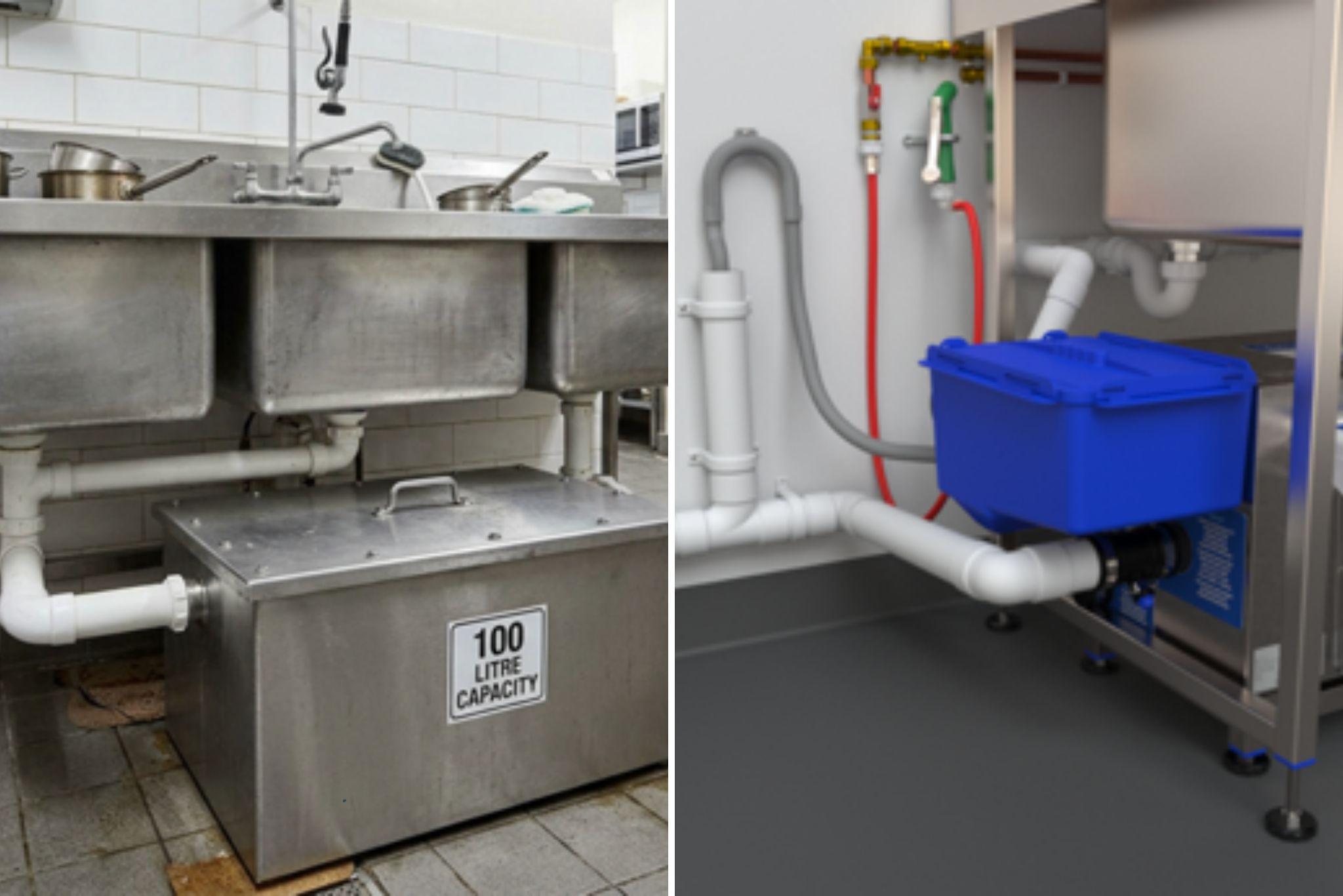
Typically, these risk areas will include a pot wash sink. We also check whether it has a pre-rinse hose, as this can influence the type and size of grease trap we recommend.
Other potential risk areas include dishwashers, wok stations, food preparation sinks, potato rumblers, pasta and other boiling pans, self-cleaning ovens connected to drainage, and floor gullies. We also need to consider wastewater temperatures and volumes, as these can influence the grease separation process.
Finding Space for a Grease Trap in an Existing Kitchen
Once the risk areas have been identified, the next job is to review the available space for retrofitting a grease trap. This can often be the biggest challenge.
With sinks, it may mean altering the sink frame or removing existing shelves to accommodate the equipment. For wok stations, manufacturers have gone to considerable lengths to design grease traps that fit neatly underneath them.
As a general guide, a typical installation might require about one metre in length, half a metre in depth and slightly more than half a metre in height. Actual dimensions will depend on the equipment selected.
We also need to consider access for future cleaning and maintenance. There’s little point in installing a grease trap that cannot be conveniently emptied or serviced!
Checking Drainage Heights and Existing Pipework
Next, we inspect the existing drainage pipework. Getting wastewater into the grease trap may be relatively straightforward, but getting it out can be another matter entirely.
The existing kitchen drainage pipework may sit higher than the grease trap’s discharge point. Because gravity drainage requires enough fall for wastewater to flow away, the outlet position and the heights of the existing pipework are particularly important.
This may mean reconfiguring some of the kitchen drainage as part of the installation. An installation can take half a day, although extensive alterations to the existing pipework can increase the time considerably. Sometimes, if drainage heights cannot be changed, a pump is the only practical solution.
What’s Included in the Grease Trap Survey Report?
Once the survey is complete, we prepare a detailed report that can be shared with the water company or landlord. It outlines the proposed type of grease trap, its capacity and dimensions, the identified risk areas, and where and how the equipment will be installed.
It also provides the answer to that all-important first question: “How much?”
Most surveys take less than an hour, and the report is usually ready within a few days. With the survey completed, the report prepared and the costs established, the only question left is: when can we arrange the installation?
Kelvin Charles
Jul 14, 2026
Alex and the team at Grease Guru have been brilliant in assisting in diagnosing and resolving ongoing drainage and grease trap issues for us. It seems that with their advice we now have a workable solution in place that has improved things all round, and all done flexibly and quickly working around our schedule.
Laurence Barwick-Smith
Jan 16, 2025
Very knowledgeable team, always responding quickly to enquiries to keep projects moving. Fast, professional service, we will certainly work with them again in the future.
Emma Sykes
Dec 22, 2022
I contacted Grease Guru looking for advice, they promptly offered a free no commitment site survey to determine our requirements. The surveyor was very helpful and explained all our options. We were then given a detailed proposal which we confirmed was acceptable with the water authority before continuing. The traps were installed soon after and have been running great since.
How Grease Guru Can Help
At Grease Guru, we complete several hundred site surveys each year. Our experience spans everything from small, independent kitchens seeking a practical solution to grease management issues to major high street brands rolling out programmes across their entire estate.
We know every kitchen is different, and getting the survey right is the first step to getting the installation right. If you’ve received a letter from your water company or need to fit a grease trap in an existing kitchen, speak to a member of the Grease Guru team to arrange your free grease management site survey.
Frequently Asked Questions
How much does it cost to install a commercial grease trap?
The cost depends on the equipment needed, the space available and how much work is required to connect it to the existing drainage. Grease Guru can give an indicative price, but a site survey allows us to confirm the proposed equipment and installation cost.
My water company has asked me to install a grease trap. What should I do?
Check what the letter asks you to address and whether it gives you a deadline. Share it with Grease Guru when arranging your survey so we can take those details into account. The survey report can then be shared with the water company or landlord to explain what is proposed.
Can a grease trap be fitted in an existing commercial kitchen?
Yes. The survey checks where the equipment can fit, how it can connect to the existing drainage and whether staff or engineers will have enough room to empty and service it. Some kitchens need changes to shelving, sink frames or pipework to make the installation practical.
Can I install a grease trap if the drain is higher than the outlet?
Yes, but the wastewater needs a way to flow away from the trap. It may be possible to alter the existing pipework to provide sufficient fall. Where the drainage heights cannot be changed, a pump may be needed.
How long does a grease trap survey and installation take?
Most Grease Guru site surveys take less than an hour, and the report is usually ready within a few days. Installation can take around half a day, although jobs that need more extensive pipework alterations can take considerably longer.